






Overview
This case involved a US-based omnichannel retailer with 40+ physical stores and a growing e-commerce operation generating roughly $45M annually. Paid media spend sat between $100K and $120K per month, with GA4 serving as the system of record for performance reporting and budget allocation. On the surface, GA4 looked healthy. Events fired. Reports populated. Nothing was throwing errors. But attribution was drifting. Revenue totals disagreed across platforms, week-to-week performance swings couldn’t be explained cleanly, and trust in the data eroded slowly. Classic GA4 attribution issues.
GAfix was introduced as a continuous diagnostic layer to isolate where GA4 tracking diverged from real revenue behavior and to prioritize fixes based on actual impact. Within 30 days, GA4 revenue aligned back to backend systems at roughly 94–95%, paid media attribution accuracy stabilized, and revenue signals that had been intermittently missing were consistently captured again.
The Challenge
What wasn’t working in GA4
Nothing was obviously broken. That was the problem.
Dashboards loaded. Weekly reports passed basic sanity checks. But performance moved too much, too often, without a clear driver. When leadership asked why CPA spiked one week and collapsed the next, every answer came with footnotes and disclaimers. The team was dealing with retail analytics attribution problems that didn’t fail loudly, yet they just distorted outcomes.
Symptoms the team kept seeing:
- Paid media performance is swinging 15–25% week over week.
- GA4 revenue mismatch against backend systems.
- Google Ads and Meta are reporting different conversion counts for the same campaigns.
- Store pickup purchases appearing inconsistently
- iOS and Safari traffic persistently undercounted
Individually, each issue was explainable. Together, they made attribution unreliable. The real risk wasn’t confusion in reporting, but it was optimization. Media platforms were bidding on incomplete signals, and leadership was making budget decisions without confidence in omnichannel conversion tracking. Backend reconciliation suggested roughly $100K–$120K per month in revenue signals were missing or misattributed. The strategy wasn’t wrong. Measurement had quietly degraded.
The GAfix Intervention: Treating Analytics Like Infrastructure
GAfix was deployed as a persistent data-integrity layer sitting above GA4, designed to surface failures before they impacted reporting or bidding algorithms.
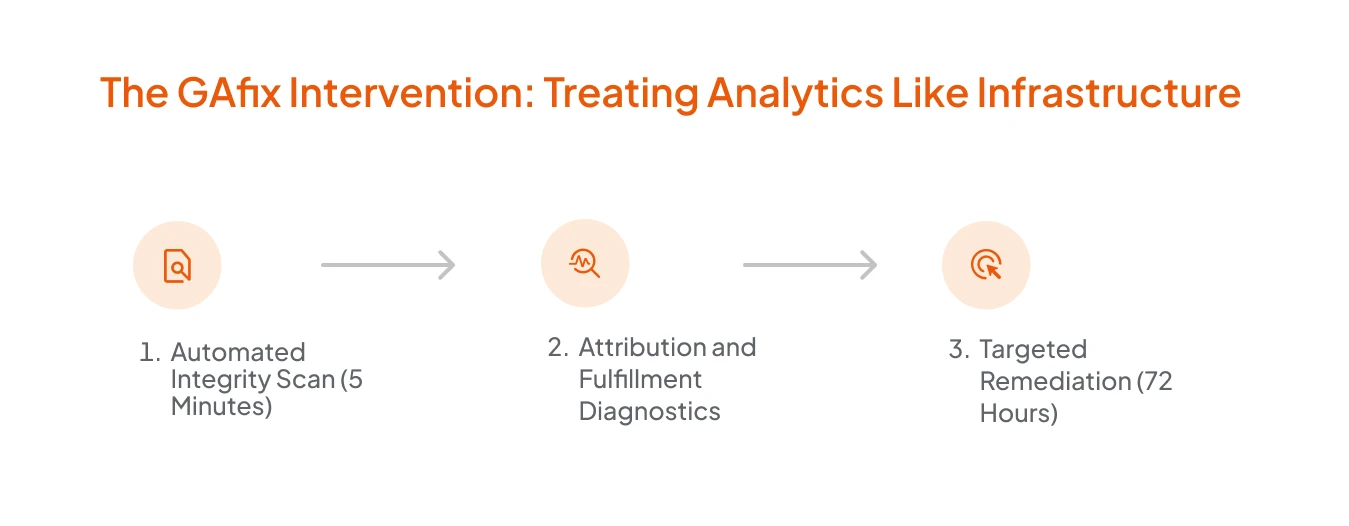
Step 1: Automated Integrity Scan (5 Minutes)
GAfix scanned live GA4 data across 120+ dynamic URLs, automatically detecting:
- Duplicate or missing transaction IDs
- Suppressed conversion events
- Cross-domain attribution breakage
- Redundant or conflicting tags
Each issue was ranked by business impact, not technical neatness, which is an important distinction when dealing with GA4 attribution issues at scale.
Step 2: Attribution and Fulfillment Diagnostics
GAfix applied deterministic logic to identify revenue paths present in backend systems but absent from GA4 attribution.
For example, store pickup purchases fulfilled correctly but missing valid transaction IDs are flagged as high-risk revenue loss. These were real orders that existed operationally but failed to survive GA4’s attribution logic. This is where retail attribution problems tend to hide.
Step 3: Targeted Remediation (72 Hours)
Using GAfix’s prioritized remediation list, the team implemented focused fixes:
- Removed 25+ redundant legacy scripts
- Stabilized cross-domain checkout tracking
- Corrected duplicate conversion firing
- Resolved consent-related mobile tracking gaps
As a secondary benefit, mobile page load time improved by ~12%, contributing to better conversion performance.

How We Fixed Issues That Cost Accuracy
The setup wasn’t broken in an obvious way. It was overloaded. Tagging had grown over time without cleanup, and GA4 was doing its best to reconcile conflicting signals.
There were 150+ active GTM tags, including legacy scripts with overlapping logic. Purchase events fired inconsistently across browsers and consent states, with Safari and iOS traffic taking the biggest hit. Cross-domain tracking dropped during certain checkout paths, especially store pickup, causing sessions to reset and transaction IDs to disappear or duplicate. Consent handling further suppressed mobile conversions without throwing any visible errors.
None of this showed up as a single failure. It showed up as drift.
What was corrected
- Removed 25+ redundant legacy GTM tags
- Fixed cross-domain checkout tracking
- Eliminated duplicate purchase and conversion firing
- Corrected transaction ID handling for store pickup
- Resolved consent-related mobile tracking gaps
After remediation, GA4 data reconciled cleanly with backend transactions across devices and fulfillment types, and attribution stabilized within days.
Results: Measured Impact in 30 Days
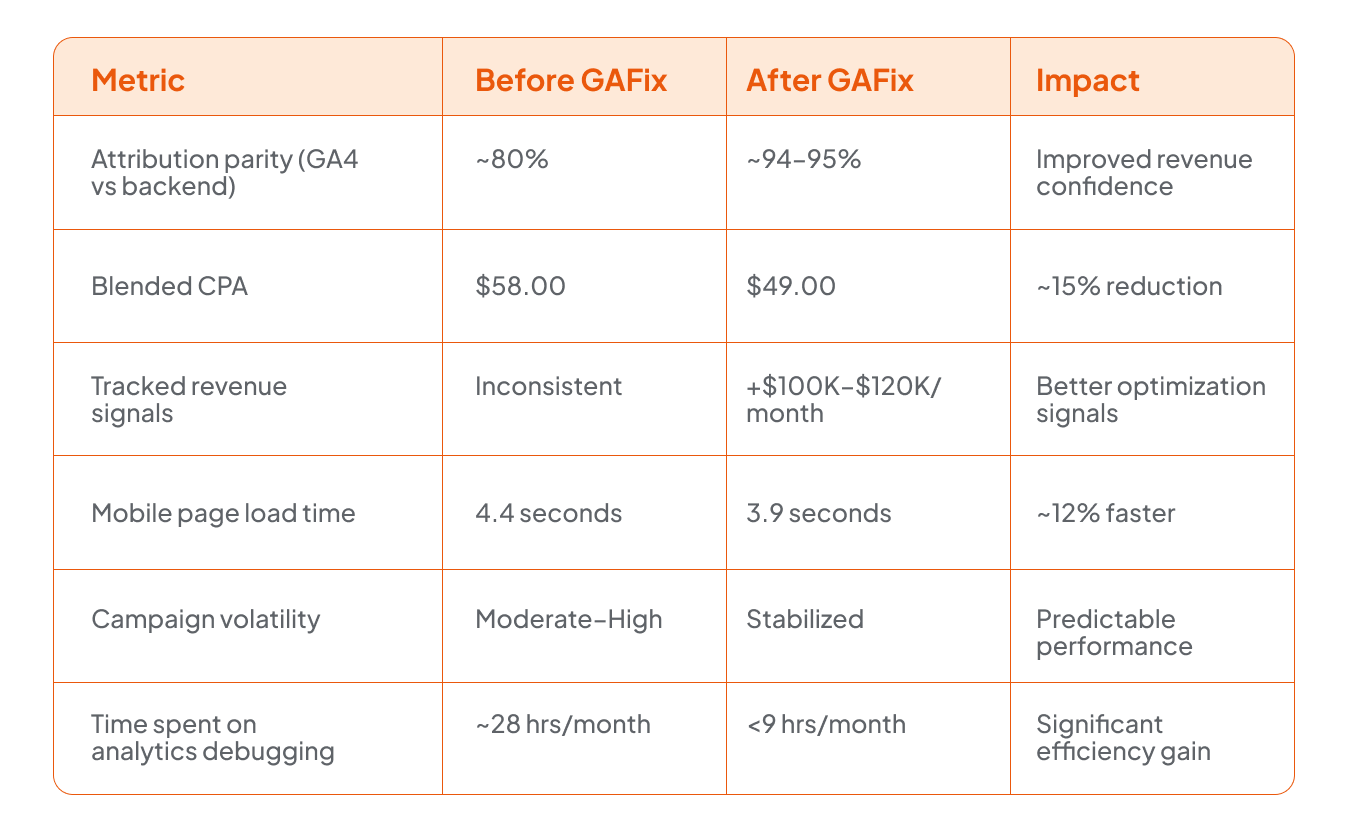
Recovered revenue here didn’t mean new demand was created. It meant orders that were already happening but weren’t reliably captured, attributed, or usable for optimization were now showing up consistently in GA4.
Once the GA4 revenue mismatch was reduced, leadership stopped interrogating every number before making decisions. Media teams stopped hesitating because of attribution doubts. Analytics work moved forward instead of looping back into revalidation and debugging, which is often where GA4 attribution issues quietly stall progress.
Takeaway
This wasn’t a bad GA4 setup. It was a normal one that had aged without guardrails. At scale, analytics don’t fail loudly. They drift. And drift is harder to catch than breakage.
If you’re spending significant money on paid media, operating across various fulfillment types, and relying on GA4 as your source of truth, the risk is rarely strategic. In reality, it’s measurement decay. GAfix didn’t replace analysts or strategy. It made the data stable enough that those things could actually work. That’s the difference between fixing analytics and protecting it.
Frequently Asked Questions
Why does GA4 attribution not match our e-commerce backend revenue?

Usually 10-12% of GA4 data differs from the e-commerce backend revenue systems. Your backend records confirmed transactions, while GA4 records user-side events that depend on cookies, consent, browser behavior, and correct event firing.
Why are Google Ads and GA4 reporting different conversion numbers for retail campaigns?
Google Ads attributes conversions based on ad interactions using its own models, lookback windows, and inferred signals. GA4 only counts conversions it can observe as consented events. As a result, conversions credited in Ads often don’t fully carry through to GA4, creating paid media attribution accuracy gaps that are especially visible in retail campaigns.
How do omnichannel retail journeys break GA4 attribution?
Omnichannel conversion tracking breaks when user journeys move between online, offline, and assisted touchpoints that GA4 cannot consistently observe. When purchases are completed outside GA4’s tracked environment or across domains, devices, or fulfillment paths, attribution credit is partially or fully lost. This is a core source of ongoing GA4 attribution issues in omnichannel retail setups.
Confident Decisions Start with Accurate Tracking
Ensure your GA4 and GTM are correctly configured, reliable, and ready for scale.

.webp)
Subscribe To Our Newsletter


