


.webp)



Overview
A US-based B2C subscription commerce brand in the wellness category, operating primarily online and generating roughly $18–20M in annual revenue.
As paid acquisition scaled and subscription renewals accounted for a greater share of revenue, leadership began to notice widening gaps between GA4, payment gateway records, and internal subscription dashboards. It was actually an early signal that the GA4 Audit Checklist and broader Google Analytics audit assumptions were no longer holding up in practice.
GA4 continued to show active event collection, but reported sign-ups, renewals, and cancellations no longer reconciled cleanly with backend systems. These GA4 conversion tracking issues reduced confidence in performance reporting and made it difficult to evaluate growth initiatives.
GAfix is a go-to GA audit analytics platform designed to continuously validate event logic, detect silent failures, and safeguard GA4 subscription tracking. It helps businesses to eliminate reliance on periodic manual reviews or a one-time GA4 audit checklist.
The Problem: When Subscription Metrics Slowly Drift
In subscription businesses, analytics rarely breaks in obvious ways. It degrades quietly.
That pattern was evident here. As the brand expanded paid acquisition across Google, Meta, and affiliates, GA4 dashboards continued to populate. Yet the distance between reported conversions and confirmed subscriptions slowly widened.
What initially looked like normal variance became persistent noise. Without appropriate adjustments to campaigns, creative, or price, conversion rates fluctuated significantly from month to month. Renewal counts fluctuated even when churn appeared stable in backend systems.
The underlying issue was not volume. It was eroding subscription analytics accuracy.
What the team observed
Month after month, performance patterns stopped behaving logically. Reported conversion rates fluctuated by 8–15% without any corresponding change in media spend, creative, or offers. Paid channels regularly showed conversions that never became active subscriptions, while trial-to-paid analysis produced different answers depending on which report was consulted. iOS traffic, in particular, appeared persistently underrepresented in subscription attribution, creating meaningful blind spots in mobile performance.
What was actually happening
Under the surface, a number of failures at the event level were getting worse over time. Subscription events were firing before payment confirmation, duplicate purchase events were triggered by refreshes or back navigation, and renewal and cancellation events intermittently failed to reach GA4. Consent-related suppression further reduced iOS visibility, and inconsistent event naming across web and mobile environments fragmented what should have been a single GA4 Audit Checklist view of subscription behavior.
Together, these failures distorted subscription revenue attribution. Paid media platforms are optimized toward partial or noisy signals rather than confirmed revenue. Approximately $35K to $45K in monthly subscription income was either misattributed or essentially invisible inside GA4, according to backend reconciliation.
Why Traditional Fixes Failed
The group went through well-known remediation patterns in turn:
- Manual GA4 event reviews
- Sprint cycles with developer-led patches included
- Spot checks inside payment gateway dashboards
Each effort addressed isolated symptoms but never established a stable baseline.
As pricing tests, funnel changes, and experiments rolled out, tracking gaps reappeared, revealing that the existing Google Analytics audit and GA4 Audit Checklist were not designed to prevent ongoing drift. The issue was not execution quality, but the lack of continuous validation of GA4 event logic and attribution paths.
The GAfix Intervention: Making Subscription Data Reliable Again
GAfix was introduced as a persistent GA4 quality-control layer focused on validating event logic and GA4 subscription tracking, rather than simply confirming that events were present.
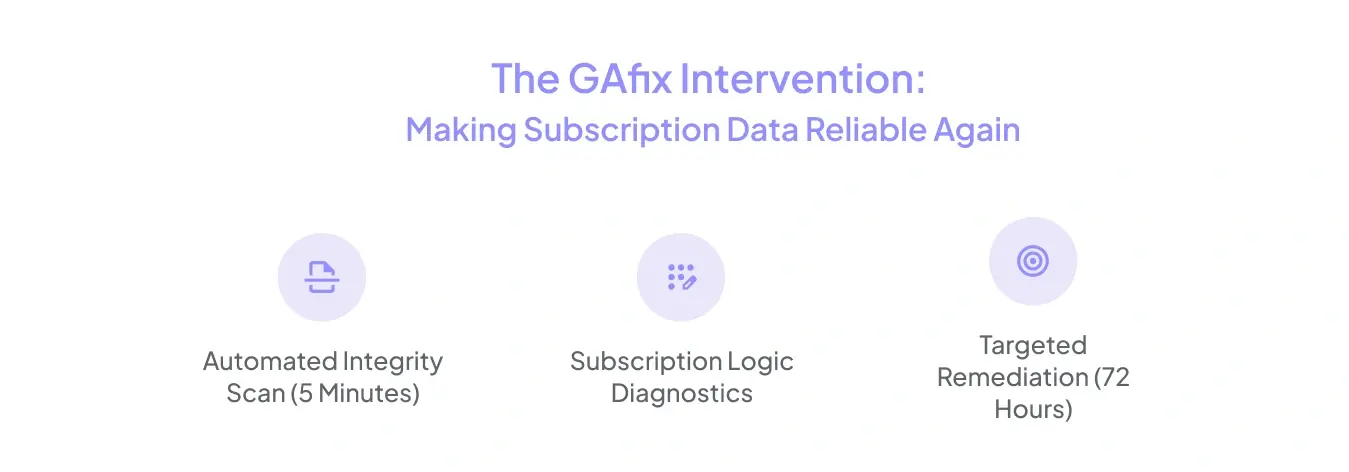
Step 1: Automated Integrity Scan (5 Minutes)
GAfix automatically identified the following after scanning live GA4 data across more than 60 subscription and funnel URLs:
- Duplicate purchase and subscribe events
- Events firing without a confirmed payment status
- Absence of cancellation and renewal indications
- Consent-related event suppression
Each issue was ranked by estimated revenue impact, allowing the team to sequence fixes instead of treating all findings as equal.
Step 2: Subscription Logic Diagnostics
GAfix applied rule-based validation to subscription flows.
Example logic:
If event = “subscribe” AND payment_status ≠ “success”, flag as high-risk revenue misattribution.
This surfaced scenarios where GA4 reported conversions that never became paying subscribers, a recurring failure mode in many Google Analytics 4 audit engagements.
Step 3: Targeted Remediation (72 Hours)
Focused fixes were implemented by the team using GAfix's priority action list:
- Subscription events were remapped to triggers that require payment confirmation.
- Duplicate purchase firing on refresh was eliminated.
- Standardized event naming across web and mobile
- Resolved consent conflicts affecting iOS tracking
As a secondary effect, funnel and cohort analysis became materially more consistent within the GA4 Audit Checklist framework.
Results: Measured Impact in 30 Days
The Outcome (within 30 days)
- ~10–12% improvement in reported conversion accuracy
- ~90–92% parity between GA4 and subscription backend data
- $35K–$45K per month in previously misattributed or untracked subscription revenue surfaced
- A repeatable data-quality layer replacing reactive GA4 debugging
.webp)
Recovered revenue refers to subscription revenue that was previously misattributed or inconsistently tracked. It is now captured in line with a GA4 audit checklist and standard Google Analytics audit practices. This makes the data usable for analysis and optimization rather than something teams compensate for manually.
Operational Impact
Beyond the figures, GAfix changed routine business operations:
- Growth teams' trust in GA4 subscription reporting was restored.
- Paid media optimization began aligning with revenue that could be verified
- Analytics teams spend less time resolving dashboard conflicts.
- Fewer unknowns were shipped in subscription tests.
Instead of serving as a reactive cleanup tool, GAfix successfully transitioned into a preventive analytics safeguard within the GA4 Audit Checklist process.

The Bottom Line
This company did not have a conversion problem. It had a measurement integrity problem.
For subscription businesses running multi-step funnels, relying on GA4 for CAC and retention, and marketing heavily on mobile and iOS, unexplained performance swings are rarely strategic issues. They stem from broken event logic and attribution integrity.
GAfix continuously protects that integrity, so growth decisions are built on real subscription revenue, not distorted signals.
Frequently Asked Questions
Why are subscription renewals and cancellations missing in GA4?

These actions occur in backend systems and are often never sent to GA4. If no event is implemented, GA4 cannot report it. A web analytics audit should confirm backend-to-GA4 event mapping and naming consistency.
Why does GA4 report subscription conversions that don’t turn into paying customers?
This usually happens when events fire on user intent (like clicking “Subscribe”) instead of confirmed payment success. GA4 records what it receives, even if the transaction never completes. A GA4 Audit Checklist should always verify that conversions are tied to verified payments, not preliminary actions.
How do I validate GA4 subscription data against my payment system?
Regularly compare GA4 subscription events with backend transaction logs using transaction IDs, order IDs, and timestamps. Look for gaps, duplicates, and mismatches. Ongoing automated validation is the most reliable way to ensure GA4 subscription tracking aligns with real payment activity.
Confident Decisions Start with Accurate Tracking
Ensure your GA4 and GTM are correctly configured, reliable, and ready for scale.


Subscribe To Our Newsletter


