





Auditing your Google Analytics 4 property is crucial to ensure that your data is accurate, reliable, and aligned with your business goals. While automated and semi-automated GA4 audit tools have made this process faster, relying solely on them is often insufficient.
In fact, research shows that approximately 87% of GA4 implementations contain at least one critical configuration error, which can compromise data accuracy and reporting if not properly audited.
These tools help spot surface-level issues such as missing events, fundamental configuration gaps, or obvious tracking errors. They work well for early assessments, quick health checks, and ongoing monitoring after a detailed audit is complete. For teams with limited time or budget, GA4 audit tools can also act as efficient shortcuts for maintaining baseline data quality.
However, Google Analytics audits go beyond technical checks. They require an understanding of how data connects to business objectives, marketing strategy, privacy requirements, and reporting needs. This is where automated tools fall short.
In this blog, we will explore the limitations of GA4 audit tools and why human expertise remains essential. We will cover how differences between businesses, varying definitions of key events, lack of contextual understanding, limited issue diagnosis, complex privacy considerations, and weak focus on reporting and activation can impact the effectiveness of Google Analytics audits.
When Google Analytics Audit Tools Are Most Useful
.webp)
GA4 audit tools are most effective when used as support tools rather than complete audit solutions. In the right scenarios, they can speed up reviews and help teams maintain baseline data quality.
- Early-Stage Checks: These tools are helpful for quickly spotting clear tracking gaps or configuration errors before committing to a detailed GA4 audit.
- Ongoing Health Monitoring: Once a thorough audit is complete, audit tools help teams perform routine checks to ensure tracking remains stable and consistent.
- Efficient Quality Reviews: For projects with limited time or budget that only require surface-level validation, GA4 audit tools reduce manual effort and improve efficiency.
- Regular Interim Reviews: When conducting lighter audits between major assessments, tools support continuous oversight and help prevent data issues from going unnoticed.
In short, GA4 audit tools work best as part of a broader audit approach, where platforms like Gafix.ai combine automation with expert-led reviews for deeper, more reliable insights.

Why Every Business Requires a Different Google Analytics Audit Approach
GA4 audit tools often assume that all businesses should follow the same measurement framework. In practice, this rarely works. Business models, customer journeys, and success metrics vary widely, and GA4 setups must reflect these differences.
Most audit tools rely on standard checklists and predefined rules. While these checks can highlight missing configurations, they do not assess whether those configurations are actually suitable for a specific business. As a result, tools may flag items that are technically “missing” but strategically unnecessary.
For example, features like User ID tracking or enhanced ecommerce events may be critical for some businesses but irrelevant for others. Without understanding how a business operates and what it aims to measure, automated tools cannot judge whether a GA4 setup is genuinely fit for purpose.
This is where human expertise becomes essential. Analysts can assess GA4 configurations in the context of real business goals, ensuring tracking decisions support meaningful insights rather than generic best practices.
Where Google Analytics Audit Tools Begin to Fall Short
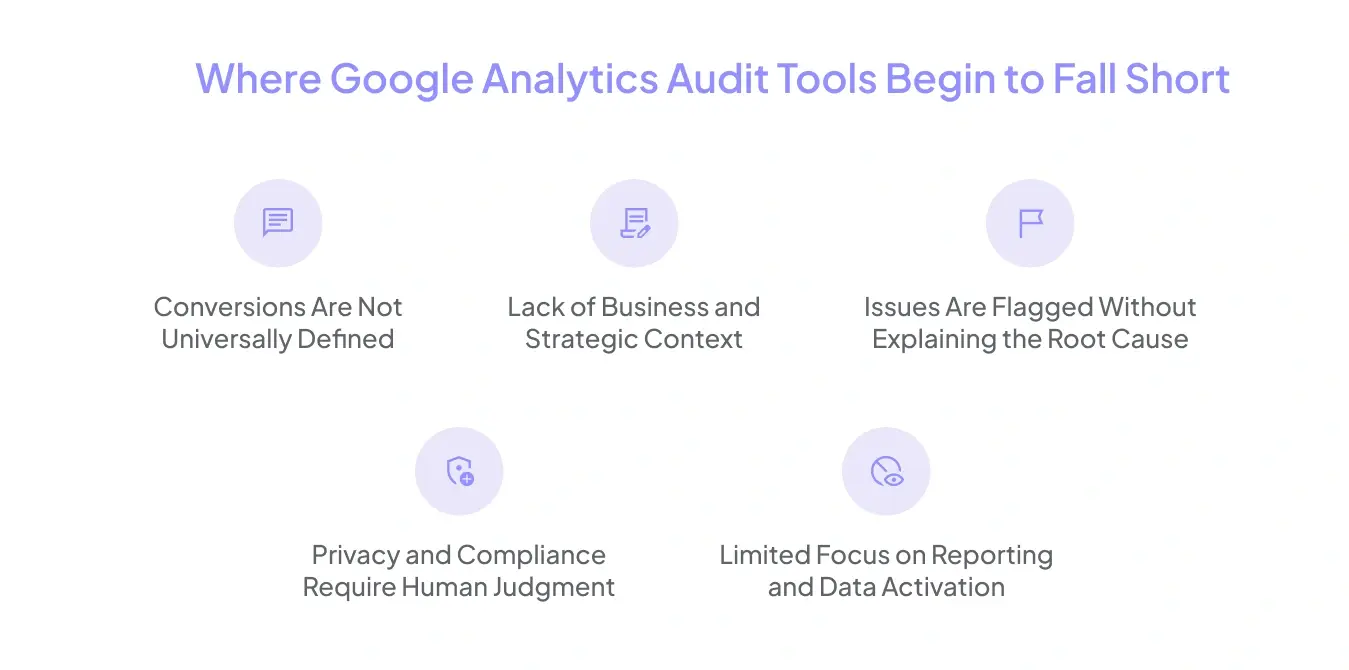
GA4 audit tools are effective for identifying surface-level issues; however, their limitations become apparent when audits require a deeper understanding and informed decision-making. At this stage, automation alone cannot evaluate whether tracking truly supports business objectives or long-term data reliability.
Below are the key areas where GA4 audit tools typically fall short:
1. Key Events Are Not Universally Defined:
Audit tools can verify whether events are marked as key events, but they cannot determine whether those events reflect meaningful business outcomes. Necessary actions may be missed, while low-value or duplicate events may be overemphasized.
2. Lack of Business and Strategic Context:
Automated tools often struggle to understand business goals, customer journeys, and marketing strategies. Without this context, they cannot assess whether a GA4 setup aligns with how data is actually used.
3. Issues Are Flagged Without Explaining the Root Cause:
GA4 audit tools often highlight what is wrong but fail to explain why it is happening. This makes it challenging to resolve recurring issues or prevent them from reappearing.
4. Privacy and Compliance Require Human Judgment
Data privacy regulations vary by region and industry. Automated recommendations may overlook nuanced compliance requirements, making human oversight essential.
5. Limited Focus on Reporting and Data Activation
Most tools focus on configuration checks rather than on how data is reported or acted upon. They do not evaluate whether reports support informed decision-making or facilitate effective data utilization.
Addressing these gaps requires more than automation, reinforcing the need for expert involvement in GA4 audits.
Conclusion
GA4 audit tools play a crucial role in enhancing efficiency and ensuring the quality of baseline data. They are beneficial for quick checks, ongoing monitoring, and early detection of issues. However, as this guide highlights, automation alone cannot deliver a complete GA4 audit.
Effective audits require an understanding of business goals, key events relevance, data usage, privacy requirements, and reporting needs. These are areas where human expertise remains essential and where automated tools consistently fall short.
The most reliable approach combines automation with expert review. By pairing structured checks with contextual analysis, businesses can ensure their GA4 data is not only technically correct but also meaningful and actionable. Platforms like Gafix follow this blended approach by supporting automated validation alongside expert-led guidance, helping teams move beyond surface-level audits toward long-term confidence in analytics.
Frequently Asked Questions
Q1. Are GA4 audit tools enough for a complete Google Analytics audit?

No. GA4 audit tools help identify surface-level issues and maintain data quality, but they lack the business context, strategic understanding, and expert judgment needed for a complete audit.
Q2. When should businesses use GA4 audit tools?
GA4 audit tools are most effective for early-stage checks, ongoing monitoring after a full audit, and brief reviews when time or budget is limited.
Q3. Why is expert review important in a GA4 audit?
Expert review ensures that conversions, tracking configurations, privacy requirements, and reporting align with business goals, a task that automated tools cannot fully evaluate.
Confident Decisions Start with Accurate Tracking
Ensure your GA4 and GTM are correctly configured, reliable, and ready for scale.

.webp)
Subscribe To Our Newsletter


